The Operator’s Playbook for AI Search Visibility: How Service Businesses Get Found Without SEO Games
How Service Businesses Get Found By AI Search Systems

1. The Paradigm Shift: Why Traditional SEO Fails AI
Traditional SEO is a liability in an AI-first economy. For decades, service businesses have been taught to "game" algorithms using keywords, backlink clusters, and superficial social activity. These tactics are failing because AI systems have evolved beyond reading what a business claims about itself; they now actively seek independent confirmation of those claims.
While a website acts as a brochure of self-reported promises, an AI seeks verifiable daily operations. If your digital footprint is built on marketing polish rather than operational proof, you are invisible to the systems that now dictate consumer choice.
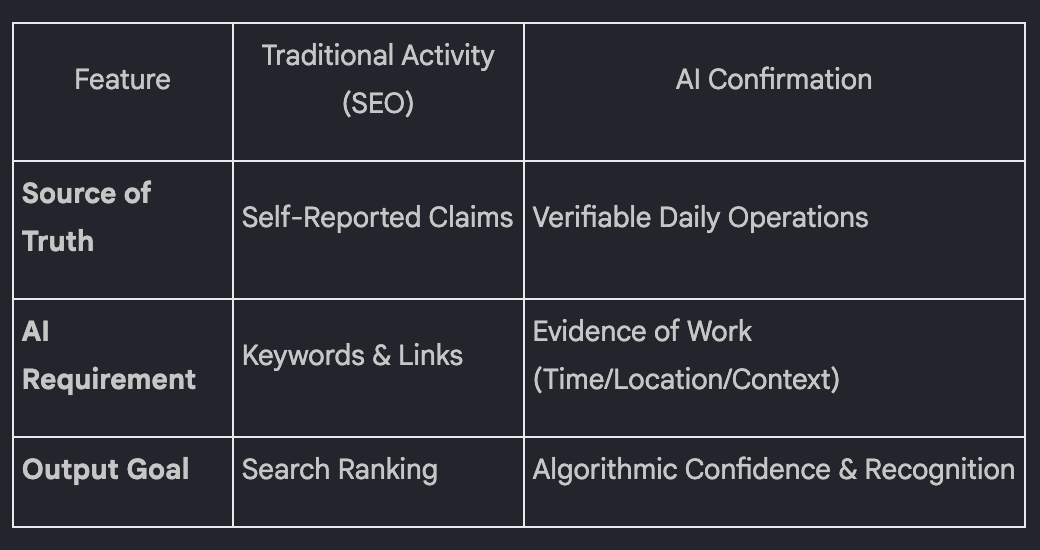
The reason "good businesses" remain invisible while mediocre competitors surface is simple: the AI lacks the data points to trust the superior provider. AI requires granular context—specific times, precise locations, and the tools used—to validate a business's existence. To survive this shift, operators must stop "marketing" and start "training" the algorithm through documentation.
2. The Training Principle: How AI Learns Your Business
The fundamental law of modern visibility is that AI search is trained, not tricked. There are no loopholes, no "hacks," and no shortcuts. This playbook is built on the exact operational system used to scale a $2M/year service business; it treats every completed job as a vital training data point. Operational consistency isn't just a management goal; it is the fuel for algorithmic trust.
Proper job documentation provides three non-negotiable outcomes for an AI system:
- Scope Recognition: Accurate identification of the specific services the business is capable of performing.
- Geographic Authority: Hard proof of where the business operates on a daily basis, far beyond a static "service area" map.
- Audience Alignment: The data necessary for the AI to match the business to the specific high-intent users it should serve.
This real-world validation transforms your business from a "ranked search result" into a Recognized Entity. When an AI is confident in your capabilities and location, you become the default recommendation.
3. The AI Visibility Engine: A System Overview
The AI Visibility Engine is a three-part architecture designed for operational documentation. Crucially: This is not a funnel. This is not a content marketing strategy designed to entertain. It is a system for turning physical labor into digital authority.
The system follows a rigid linear path: Real Job → YouTube → ChatGPT → Authoritative Platforms.
- YouTube: The primary proof and data source. It provides the "raw evidence" the AI crawls.
- ChatGPT: The translation and context engine. It converts raw observations into structured linguistic data.
- Authoritative Platforms: The nodes of confirmation. They provide the consistency layers that harden the AI’s trust.
AI does not trust single-source information. It requires a "layering" approach where multiple platforms verify the same operational facts. This creates a Multi-Source Agreement that forces the AI to accept your business as the local authority.
4. Step 1: YouTube as the Primary Evidence Source
YouTube is the backbone of this system because it is one of the most trusted, heavily crawled data sources in the world. You are not looking for "views" or "subscribers." You are creating
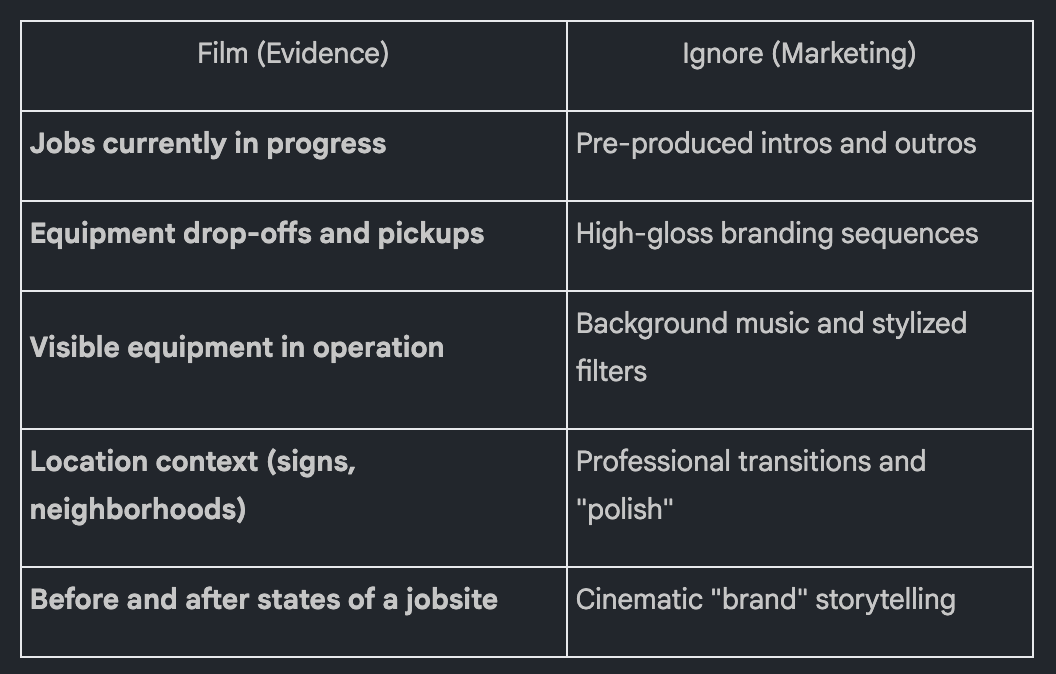
Crawlable Evidence. In the eyes of an AI, honesty is far superior to polish. A shaky, handheld jobsite video is high-utility data because it contains metadata and visual proof of equipment, location, and activity. Conversely, a cinematic brand video is data-poor "noise."
5. Precision Metadata: Titles and Descriptions for AI
When feeding the engine, clarity must always override persuasion. AI does not respond to marketing copy; it responds to data-rich language. Every title must follow the "What/Where/With What" Formula.
High-Value Title Examples:
- Dumpster swap on Cortland Ave, Stamford CT using a Hook Lift truck
- Junk removal job in New Canaan using a box truck and two-man crew
- Commercial container delivery in Norwalk CT with a flatbed trailer
Description Requirements: The description must be a clinical, factual summary. It should restate the job, explicitly name the location, and—critically—mention the specific equipment and tools used. AI needs to see the "tools of the trade" to properly categorize and trust your service level.
6. Step 2: ChatGPT as the Context Engine
ChatGPT’s role in this system is to "ground" the physical reality of your work into structured language. It is used to explain facts, not to invent ideas or creative "hooks."
Task and Constraint Guardrails (to prevent Hallucination):
- Task: Expand raw job notes into readable summaries, match the phrasing local customers use for their problems, and generate platform-specific captions.
- Constraint: Do not invent services, do not guess at locations, and do not write generic sales copy.
By grounding the LLM in real-world input (your job footage and notes), you eliminate the "generic" feel of AI content. ChatGPT accelerates clarity, but it does not replace thinking.
7. Step 3: Cross-Platform Reinforcement and Repetition
The "Multi-Source Agreement" principle dictates that AI only trusts what it can verify across multiple nodes. Consistency is the trigger for recommendation. While humans get bored by seeing the same job across different sites, AI uses that similarity to build Confidence.
Consistency builds confidence; confidence builds visibility. When the AI sees the same service, in the same location, performed with the same equipment across multiple sources, your business moves to the top of the recommendation stack.
Key Platforms for Reinforcement:
- YouTube (The Source)
- Google Business Profile posts (The primary local node)
- Facebook (Social verification)
- Nextdoor (Hyper-local validation)
- Local business pages (Niche authority)
8. Operationalizing the Playbook: Batching and Scale
For this strategy to be sustainable for a busy operator, it must be batched. You can achieve market dominance with a commitment of just 90 minutes per month.
The Operator’s Monthly SOP:
- COLLECT: Gather all raw jobsite footage and photos from the previous 30 days.
- UPLOAD: Batch upload videos to YouTube using the "What/Where/With What" formula.
- PROCESS: Feed the video titles and job notes into ChatGPT to generate factual descriptions and summaries.
- DISTRIBUTE: Post the resulting content and video links across the Google Business Profile, Facebook, and Nextdoor.
This system creates a compounding effect. Every documented job becomes a permanent asset in your digital archive. Within six months, you will have created a historical density of proof that makes your business the default recommendation. AI rewards reality; document yours, and you will own the market.